
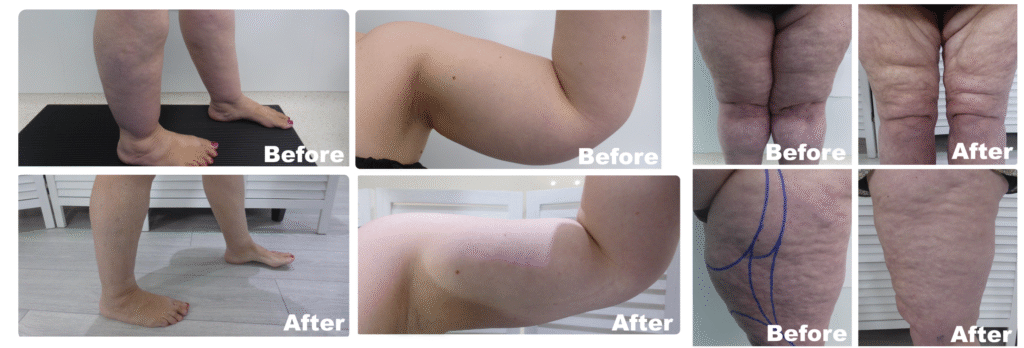
Lipoedema is a chronic and progressive disorder characterised by an abnormal accumulation of subcutaneous fat, that mainly is symmetrical distribution in the hips, thighs, buttocks, knees and sometimes the upper arms. The hands and feet are usually spared, giving the body a characteristic disproportionate shape with a small waist and bigger legs.
There are still aspects of lipoedema that are poorly understood. Unlike general obesity, lipoedema fat is painful, nodular, and resistant to diet or exercise. Symptoms often worsen over time and can affect quality of life, mobility, and emotional wellbeing.
In Lipoedema, lipocytes, capillaries and venules are involved. An increased number and size of lipocytes results in increased fat volume, which causes hypertrophy and hyperplasia, increased permeability of the capillaries causes oedema, and increased fragility of venules leads to the development of a haematoma. Oedema is the main and most obvious cause of pain in people with lipoedema, so conservative therapy which reduces oedema can lessen the pain suffered. There are probably other factors causing pain, but oedema seems to be the most obvious.
Lipoedema mainly develops in adult females but males are not affected. In most cases, lipoedema starts after puberty, a time when women want to look slim and beautiful. For some people lipoedema continues to progress until the end of life and is accentuated by pregnancy, birth and other hormonal changes, such as the menopause. In others, it remains at a steady level without progressing.
The disease can also develop later in life. The condition is under-recognised due to limited medical training, overlapping symptoms with obesity or venous disease, and the absence of standardised diagnostic criteria.
At Hunar Clinic, Dr Puneet Gupta and his team are committed to raising awareness, educating both patients and healthcare professionals, and offering accurate diagnosis and tailored treatment plans and long-term management to reduce pain and discomfort.
Lipoedema is often mistaken for lymphoedema or excess weight gain. However, it has distinct clinical features:
Understanding these differences is crucial, as misdiagnosis can delay effective treatment and worsen symptoms. Targeted compression therapy and manual lymphatic drainage (MLD) can help reduce swelling and improve lymph flow through the lymphatic system.
Lymphoedema exists in two distinguishable forms, primary and secondary lymphoedema.
Lymphoedema is the abnormal accumulation of lymph fluid in adipose tissues of the arm or leg. This causes a swelling in the affected limb. This has resulted from an impaired lymphatic system. The lymphatic system is a network of vessels and nodes, otherwise known as lymph glands, that drain excess waste fluids from the body’s tissues into the bloodstream.
Lymphoedema can limit mobility and cause pain and discomfort, disfigurement and distress and for infections to reoccur.
Primary lymphoedema develops as a result of rare congenital conditions with either a hereditary or non-hereditary basis; this can deform and affect the function of the lymphatic transportation system.
Lymphoedema can also occur if the lymph glands have been damaged or removed during a surgical procedure, radiation, infection or injury due to cancer. It is the most common type of chronic lymphoedema and is known as secondary lymphoedema.
An impaired lymphatic system causes a build-up of fluids, proteins and other tissue elements within the interstitial space. High levels of protein and toxins found in lymph causes a local inflammatory reaction, adipose tissue hypertrophy and fibrosis which result in swelling, loss of function, disfigurement and recurrent skin infections.
Genetic and Hormonal Factors:
Lipoedema often runs in families, suggesting a clear genetic association. The condition also shows a strong link with hormonal imbalance, as it frequently develops or worsens during periods of hormonal change — such as puberty, pregnancy, or menopause. These factors explain why the disorder predominantly affects women and why lifestyle measures alone rarely improve it.
The aim for treating lymphoedema/lipoedema using available treatments is to decrease the swelling, pain and discomfort and is usually conservative. Manual Lymphatic Drainage (MLD) Although conservative therapy in the form of manual lymphatic drainage (MLD) helps to reduce the accumulated oedema in the affected limb/tissue, it has no effect on the reduction of the volume of fat. The MLD uses massage techniques to help drain lymph fluid away from the limb and are usually performed within 20–60-minute sessions.
Most patients will have an improvement in reduction of oedema resulting in a decrease in pain and discomfort; however, their body shape will not change as the fat volume in the affected limb remains the same.
Compression Hosiery: Having MLD treatments will reduce the oedema within the affected limb however the effects of this may only last for a few days before it returns. The use of compression hosiery along with MLD treatments will prolong the effects of MLD, lessening the chances of a relapse. This is known as decongestive lymphatic therapy (DLT). The effects of this combination therapy, however, is short lived and will need to be repeated again at least one week later and continued thereafter.
Liposuction: To provide longer term improvements the surgical options can be offered to treat lipoedema.
The aim of surgery is to reduce the size of the affected limb by removing subcutaneous fat tissue. Liposuction for chronic lymphoedema/lipoedema involves the removal of the fatty tissue through several small incisions. The aim of this surgical procedure is to reduce the fat volume of the affected limb. Although it does not completely address underlying pathology in patients with Lipoedema/lymphoedema, the removal of fat means that the disease is no longer visible and has an impact on improving patients’ quality of life. The Procedure so called Micro-cannula liposuction – using very small hollow stainless-steel tubes are used for the removal of fat from deposits under the skin in Lipoedema patients under tumescent anaesthesia. This procedure is the most safest and effective form of treatment for lipoedema. The instrument made of the small hollow stainless-steel tubes of 1-3 mm in diameter used for removing fat. The use of fine, precise instruments means less bruising, minimal discomfort, and a faster recovery. The tumescent liposuction approach typically uses large volumes of a diluted solution, containing lidocaine and epinephrine. The anaesthetic drug inside the solution numbs the whole area, causes fat cells to swell up and breakdown and shrinks the blood capillaries in the area to minimise blood loss. This achieves a very effective and long-lasting anaesthesia of skin and subcutaneous tissue. Tumescent micro cannular liposuction, when done correctly and in the right quantity, is proven to be the safest form of liposuction. This is because the anaesthetic solution shrinks the capillaries thereby reducing surgical blood loss. Complications arising from microlipo are thus extremely rare.
Procedure: These micro-cannulas are inserted into 1mm adits/holes that are made into the skin, and fat is aspirated with the assistance of a powerful vacuum pump. Once the small adits/holes are made, the area being treated will be infiltrated with local anaesthetic. The area will be filled up with the local anaesthetic until the area is full and hard hence the name Tumescent Anaesthesia. After leaving the tumescence approximately 30-minutes to take effect, the fat will then be ready to be aspirated. Once surgery is completed the nurses will dress the treated area with sterile super absorbent dressings along with netting to secure the dressings in place. This is then immediately followed by the compression garments. This is to control bleeding and to minimise the development of post-operative oedema and bruising. The compression garments are required to be worn for 24 hours per day, typically for a minimum of 3 to 6 days, although many patients choose to wear the garments longer because of the comfort they provide. Wearing the post-op garment for more than the minimal number of days is of no significant advantage in terms of the ultimate cosmetic results.
Any surgery involves the risk of infection, bleeding, scarring or serious injury, however tumescent liposuction has an amazingly good safety record. One of the reasons Microcannular Liposuction is so safe is that NO general anaesthesia is required. A recent survey involving over 15,000 patients who had tumescent liposuction without general anaesthesia revealed no serious complications, no serious infection, no hospitalizations, no blood transfusions, and no deaths. The greatest risks of liposuction are those associated with general anaesthesia. By eliminating general anaesthesia, the risks of liposuction are dramatically reduced. Patients can minimize the risk of surgical complications by not taking medications or over-the- counter preparations that might adversely affect the surgery.
Risk of Irregularities of the Skin: Microcannular Liposuction is the least likely to cause any significant or noticeable post-surgical irregularities of the skin. By magnifying the fatty compartment, the tumescent technique permits more accurate removal of fat, with greater assurance that the liposuction cannula will not inadvertently approach too near the under surface of the skin and thereby cause irregularities. Thus, the tumescent technique helps to minimize the risk of post-surgical irregularities or rippling of the skin. Liposuction might improve per-existing irregularities of the skin such as dimpling or cellulite, but prospective patients should not assume that there will be significant improvement. It is unrealistic to expect perfectly smooth skin. Patients should expect that their skin will have approximately the same degree of dimpling and irregularities as existed before tumescent liposuction surgery. After tumescent liposuction the skin texture should be within normal limits. Because skin tends to lose some of its elasticity with increasing age and with cumulative sun exposure, older patients may notice an increase of fine wrinkles in areas such as the upper abdomen after liposuction.
Incisions for liposuction may result in scarring. Tiny (1 to 2 millimetre) round holes in the skin, called adits, are used for inserting the cannulas through the skin and into the fat. Typically, when adits/incisions heal they become virtually visible. Although you may be able to find them upon close examination, most other people would not be able to see them. Some patients may have a genetic predisposition for persistent discoloration at incision sites. Anyone who has previously experienced hyper-pigmentation or hypopigmentation (pale of light-coloured scars) of the skin in the past might expect to also experience it with liposuction adits. Certain areas of the body, such as the back of upper flanks, may be more likely to have pigmentation changes. Skin is an elastic organ; it usually retracts back after liposuction. Quality of the skin is assessed during consultation, if the skin quality is poor, patients are informed at the consultation and other options are discussed.
Liposuction of the thighs, while improving the silhouette, does not necessarily eliminate the subtle “puckering” of the skin often called “cellulite”. Cellulite results from the pull of fibrous tissue that connects skin to underlying muscle. While tumescent liposuction may reduce the degree of cellulite, it is unlikely to eliminate it. Liposuction should not worsen cellulite.
Liposuction can produce some irregularities of the skin which can be visible in certain conditions of lighting. In general, the smoothness of the skin is much improved after microcannular liposuction. These are usually rather subtle, and imperceptible to the casual observer. It is reasonable to expect significant improvement, but the results are rarely perfect.
Liposuction is not an appropriate treatment for obesity. Liposuction is not a substitute for a prudent diet, good nutrition and regular exercise. Obese patients may be good candidates for limited liposuction if their goal is simply to improve the shape of certain limited areas of the body. Obesity is associated with an increased risk of surgical complications.
GMC-registered doctor with proven track record and experience. Independent patient reviews are the best way to know your doctor’s credentials and quality of work.
Do your research and then go for consultation to gather all information before making an informed decision.
Dr Puneet Gupta: has treated nearly 8,000 patients suffering from Lipoedema. He is well regarded in the cosmetic surgery industry Dr Gupta is among the very few doctors in the UK and Europe to offer tumescent microcannular liposuction, or ‘Microlipo’ for Lipoedema patients. He is a specialist, and one of only a handful of practicing doctors in the UK and Europe trained extensively in the art of microcannular liposuction by the American inventor of the procedure, Dr Jeffrey Klein. He is GMC registered, member of BCAM, founding member of Lipoedema World Alliance (LWA), Specialist advisor to Lipoedema UK and Founder/Medical director of Hunar Clinic. His patients have found a Facebook group ‘’called Gupta Girls’’ to share their experience with Lipoedema and having micro liposuction with Dr Puneet Gupta. He takes extreme passion in treating his patients with safety, precision and care
Price from £4,500 per area.
Price dependent on the area of treatment, complexity, number of surgeries required and if I.V sedation is required or not.
It’s a complex issue. Yes, it’s a price-sensitive market, but it’s important to weigh what you pay against what you receive in return. We believe it’s a myth that treatment abroad is significantly cheaper but that’s no longer the case. When you factor in the cost of travel, accommodation, taking a family member along, and most importantly, the risks of being cared for in a non–English-speaking environment, the overall cost often equals or even exceeds that of treatment here. Cost and risk involved of keep going back for multiple surgeries as lipoedema patients required.
From what we’ve heard from colleagues and patients, the surgery prices abroad are comparable, but you add the stress and uncertainty of travelling for medical care. Many procedures in countries such as Spain, Germany, or Turkey are also performed under general anaesthesia, which carries its own risks.
Ultimately, it comes down to individual choice — how much is saving a small amount of money really worth compared to your own safety? You can’t put a price on well-being, safety, and peace of mind. When liposuction goes wrong and it can, the consequences can be severe and even fatal. So, while everyone must make their own decision, these are crucial factors to consider.
Diagnosis can be made in NHS but treatment is not offered on NHS.
I cannot express enough gratitude to Dr Gupta and his team for the transformative care provided to me. I suffer from lipedema and over time from my mid/late 20’s to early 40s, I had helplessly watched my legs (and then arms) change dramatically, leaving me feeling deeply self-conscious and trapped in a body that no longer felt like my own. No amount of exercise helped. Every glance in the mirror—whether dressed or undressed—was a painful reminder of my struggle, and my self-esteem had been eroded away over the years. I had consulted with many doctors before meeting Dr. Gupta, and each appointment left me feeling more discouraged and hopeless. Finally meeting Dr. Gupta and discovering that there was something that could be done to manage the aesthetics of my condition felt like a dream come true.
Deciding to undergo micro-liposuction was a big step for me, but without a doubt, it turned out to be one of the best decisions of my life. Thanks to Dr Gupta’s expertise, precision, and understanding, the procedures have been nothing short of life-changing. Not only has my physical appearance been hugely improved, but my confidence has also returned in ways I never thought possible. To be able to wear clothes I love and finally feel at ease in my body feels like a miracle. Dr Gupta has given me a new lease on life—one filled with self-acceptance, positivity, and empowerment.
From the very beginning, Dr Gupta created an atmosphere of ease and reassurance, blending pure professionalism with a friendly, lighthearted approach that made the experience much less daunting. His warm demeanor and thoughtful care made me feel supported every step of the way.
The expertise, compassion, and dedication Dr Gupta demonstrated throughout the entire process was truly outstanding. I highly recommend his services to anyone seeking life-changing treatment for lipoedema.
If you suspect you may have lipoedema, or if you have been misdiagnosed in the past, a specialist assessment can make all the difference. A personalised plan may include compression therapy, pneumatic compression devices, or manual lymphatic drainage alongside medical or surgical treatment to control symptoms and reduce swelling.
Contact to book a personal consultation with Dr Puneet Gupta, one of the UK’s leading experts in lipoedema diagnosis and treatment.
Dr Puneet Gupta’s Clinic 07500898562
 info@drpuneetgupta.co.uk
0175 388 2239 - 0750 089 8562
info@drpuneetgupta.co.uk
Hunar Clinic, Old Amersham Rd, Denham, Gerrards Cross SL9 7BG, United Kingdom
Copyright Hunar Clinic © 2025 All Rights Reserved